Key takeaways:
- Mental illness is common, but mental health education is not widespread.
- Mental health literacy is having the knowledge and tools to promote mental health, recognize signs and symptoms, and seek help without being held back by stigma.
- Mental Health Collaborative delivers evidence-based programs to provide mental health literacy education to schools, workplaces, and communities.
At Mental Health Collaborative, we help individuals, schools, organizations, and communities develop mental health literacy to empower them with knowledge and tools and to reduce stigma. But what exactly is “mental health literacy”? Why is it important?
First–what do we mean by “health literacy”?
Health literacy is having the knowledge and tools we need to understand, access, and use information to care for our well-being.1 Among other benefits, having high health literacy allows people to care for their own health and that of their communities.2
So, what is “mental health literacy”?
Mental health literacy has 4 components:
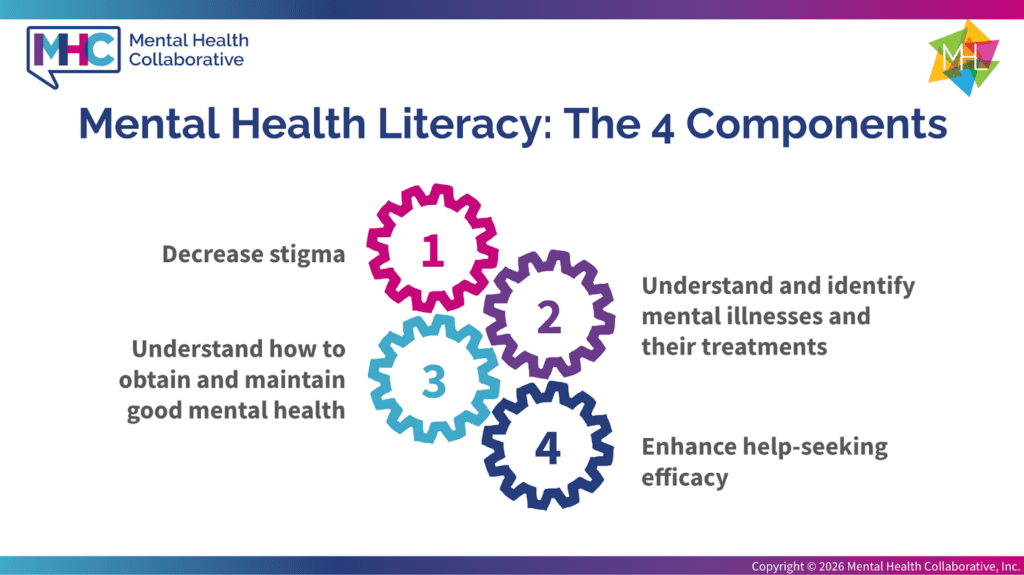
- Decreasing Stigma: dispelling myths and misconceptions about mental illness and opening up conversations about mental health
- Understanding Mental Illnesses & Their Treatments: recognizing the signs and symptoms of mental illnesses to look out for and know what is not a mental illness but normal shifts in mood
- Promoting Positive Mental Health: understanding strategies to build resilience, take care of ourselves and others, and provide support when needed
- Enhancing Help-Seeking Efficacy: knowing when, where, and how to find mental health treatment
Despite its importance, many people never receive mental health literacy education. Funding for mental health education is limited and inconsistent,3 so people often do not have the opportunity to learn about it. This is particularly true for various immigrant communities,4 5 6 racial and ethnic minority groups,7 people with lower levels of education, and other marginalized groups. Mental health literacy education programs aim to narrow those gaps.
Why is mental health literacy important?
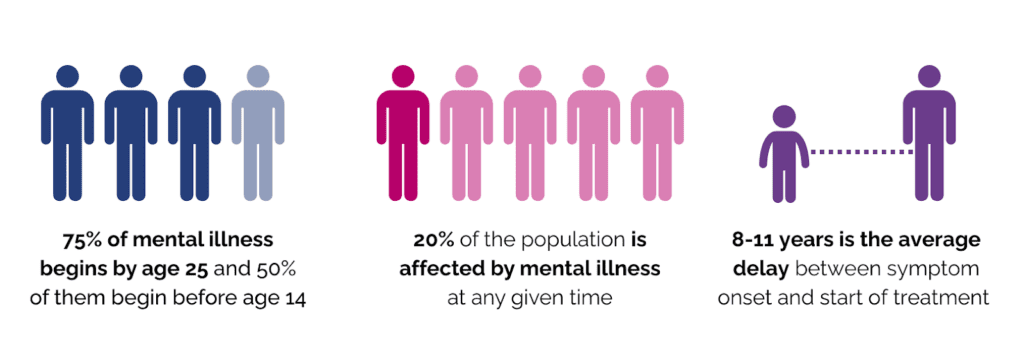
- 75% of mental illnesses begin before age 25 and 50% begin before age 14.
- 20% of the population is affected by mental illness at any given time.
- On average, it takes 8-11 years for people who have developed symptoms of a mental illness to get help.8
The numbers above show that mental illness is very common, but it often takes a long time for people to get treatment because of stigma, not recognizing the symptoms, and other reasons. The good news is that increasing mental health literacy can prevent suffering and, in some cases, save lives.
How does Mental Health Collaborative promote mental health literacy?
Mental Health Collaborative provides evidence-based Mental Health Essentials programs for students and teens, educators, coaches, parents & caregivers, professionals, and community members. These programs are prevention-focused and equip individuals and organizations with a shared language, practical tools, and clear pathways to access support.
Everyone needs mental health literacy education. When teens feel comfortable asking for support, parents & caregivers know how to navigate treatment, educators know what signs and symptoms to look for, and employers know how to build mentally healthy workplace cultures, everyone benefits. This is how our programs build resilience in individuals, organizations such as schools and workplaces, and entire communities.
The bottom line
Mental health literacy benefits everyone, whether or not they are experiencing mental illness. In addition to practical benefits like identifying accessible mental health resources and learning how to obtain and maintain their mental health, it opens up conversations and reduces stigma. When mental health literacy becomes part of everyday education, prevention becomes possible, and communities are stronger as a result.
- World Health Organization. (2015, December 22). Health literacy. World Health Organization. https://www.who.int/news-room/fact-sheets/detail/health-literacy ↩︎
- Coughlin, S.S., Vernon, M., Hatzigeorgiou, C., & George, V. (2020). Health Literacy, Social Determinants of Health, and Disease Prevention and Control. J Environ Health, 6(1), 3061. https://pmc.ncbi.nlm.nih.gov/articles/PMC7889072/
↩︎ - Heinrich C.J., Colomer A., & Hieronimus M. (2023). Minding the gap: Evidence, implementation and funding gaps in mental health services delivery for school-aged children. Child Youth Serv Rev., (150). https://doi.org/10.1016/j.childyouth.2023.107023
↩︎ - Kaçan, H., Bayram Değer, V., & Çi̇fci̇, S. (2025). The relationship between mental health literacy and psychological support-seeking attitudes in Syrian immigrant students. BMC Public Health, 25(1), 3223. https://doi.org/10.1186/s12889-025-23816-8
↩︎ - Lopez, V., Sanchez, K., Killian, M. O., & Eghaneyan, B. H. (2018). Depression screening and education: an examination of mental health literacy and stigma in a sample of Hispanic women. BMC public health, 18(1), 646. https://doi.org/10.1186/s12889-018-5516-4
↩︎ - Na, S., Ryder, A.G., & Kirmayer, L.J. (2016). Toward a culturally responsive model of mental health literacy: Facilitating help‐seeking among East Asian immigrants to North America. American Journal of Community Psychology, 58(1-2), 211-225. https://doi.org/10.1002/ajcp.12085
↩︎ - Heyl, J.C. (2023, July 5). Health literacy: The overlooked treatment gap & its impact on BIPOC mental health. Verywell Mind. https://www.verywellmind.com/health-literacy-the-overlooked-treatment-gap-7553078
↩︎ - National Alliance on Mental Illness (2025). Mental health by the numbers. National Alliance on Mental Illness. https://www.nami.org/mental-health-by-the-numbers/
↩︎