
Key takeaways:
- Mental health refers to mental well-being, while mental illness refers to diagnosable conditions like Depression or Anxiety.
- A person can have a mental illness and still have good mental health. Similarly, being mentally healthy means more than the absence of a mental illness.
- Everyone has mental health and can take action to support their own and others’ social and emotional wellness.
We hear the term “mental health” often–in schools and workplaces, in the news, on social media, and in other settings. It’s a broad term, sometimes referring to ways to stay emotionally healthy, and sometimes referring to mental health conditions or mental illness. So, what does “mental health” actually mean? And what does “mental illness” mean?
Definitions
The United States Substance Abuse and Mental Health Services Administration (SAMHSA) defines mental health as “our emotional, psychological, and social well-being…[that] affects how we think, feel, and act, and helps determine how we handle stress, relate to others, and make choices.”1
On the other hand, SAMHSA defines mental illnesses as “disorders, ranging from mild to severe, that affect a person’s thinking, mood, and/or behavior.”2
The key difference is that mental health refers to well-being and mental illness refers to diagnosable conditions like Depression or Anxiety. That said, the terms are not mutually exclusive. Some people have mental illness, but everyone has mental health. Let’s explore more below.
More than an absence of mental illness
Mental health goes beyond not having a mental illness. Researchers developed a graph that names four states people can be in depending on their current levels of mental health and mental illness: 3
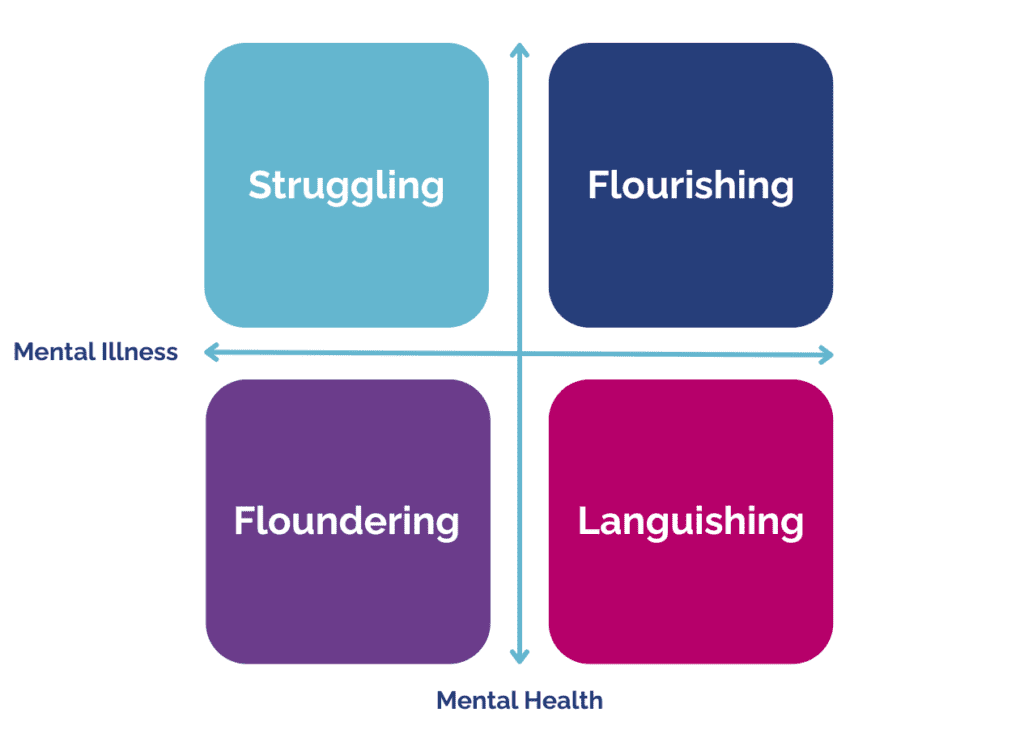
- Struggling is when we are experiencing signs and symptoms of a mental illness with insufficient treatment, and we have positive coping skills, social supports, and tools to promote our mental health.
- Floundering is when we are experiencing signs and symptoms of a mental illness with insufficient treatment and we lack coping skills and supports.
- Languishing is when we do not have a diagnosable mental illness, but we also lack mental health promotion tools that help us build resilience and experience positive emotions.
- Flourishing is when we either do not have a diagnosable mental illness or have a mental illness that is well-managed with treatment, and we have positive coping skills, social supports, and tools to promote our mental health.
Another way to think about this is that treatment for mental illness takes someone from -10 to 0, but improving their mental health can take someone from 0 to 10 and help them flourish.4
What are some strategies for obtaining and maintaining mental health?
Fortunately, there are a number of steps people can take themselves to improve and maintain their mental health, including:
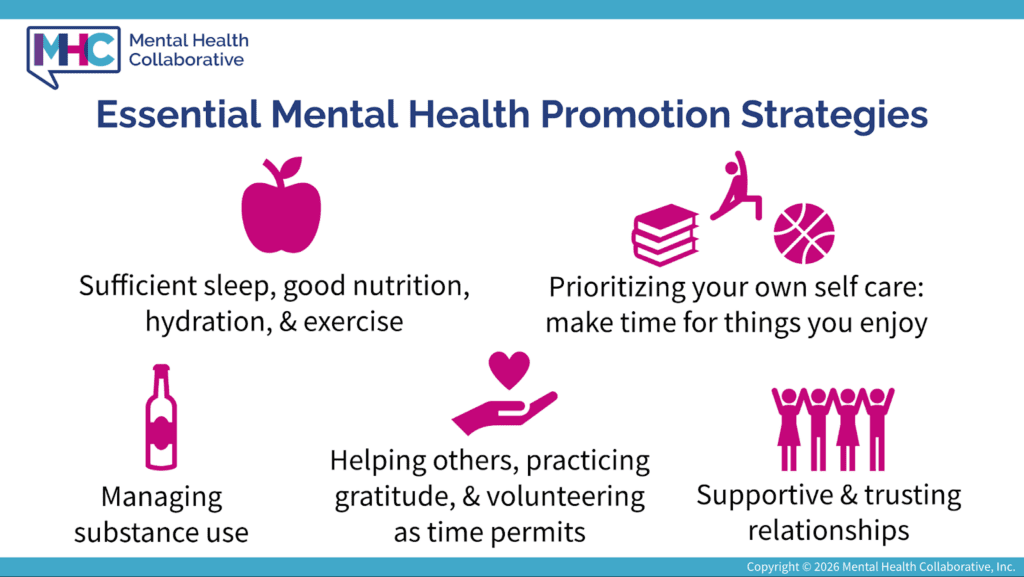
- Getting enough sleep, good nutrition and hydration, and regular exercise.
- Using breathing exercises to manage stress.
- Prioritizing their own self care by making time to do things they enjoy.
- Managing and limiting their time on social media.
- Helping others, practicing gratitude, and volunteering as time permits.
- Seeking out supportive and trusting relationships.
These can be helpful to everyone–whether or not we have a mental illness. That said, we recognize that not everyone has the time and resources to prioritize their own mental health. We encourage people to take any steps that are realistic and helpful to them, and leave the rest.
The bottom line
Mental health and mental illness are distinct concepts, though they can influence each other. It’s important for everyone to take steps, as possible, to boost their own mental health and support those around them in doing the same.
Mental Health Collaborative’s mission is to build resilient communities through mental health education and awareness, empowering individuals and organizations to promote mental health. Sign up for our (free!) e-newsletter to learn about our programs and impact, or bring mental health education to your school, organization or community today.
- Substance Abuse and Mental Health Services Administration (2024, November 8). Mental health. U.S. Department of Health and Human Services, Substance Abuse and Mental Health Services Administration. https://www.samhsa.gov/mental-health
↩︎ - Substance Abuse and Mental Health Services Administration (2024, October 31). Mental health conditions. U.S. Department of Health and Human Services, Substance Abuse and Mental Health Services Administration. https://www.samhsa.gov/mental-health/what-is-mental-health/conditions
↩︎ - Keyes, C.L.M., & Martin, C.C. (2017). “The complete state model of mental health.” In M. Slade, L. Oades, & A. Jarden (Eds.), Wellbeing, recovery and mental health (pp. 86–97). Cambridge University Press. https://doi.org/10.1017/9781316339275.009
↩︎ - Seligman, M.E. (2011). Flourish: A visionary new understanding of happiness and well-being. Simon and Schuster.
↩︎